
Unveiling the Mysteries of 3I/ATLAS
In a remarkable astronomical event, the interstellar object 3I/ATLAS has caught scientists’ attention by unexpectedly amplifying gas emission levels and undergoing rapid mass loss as it approached its perihelion – the closest point to the Sun. According to Harvard astrophysicist Avi Loeb, the object shed material at an astounding rate of about 2 million kilograms per second. This rate far exceeds the behavior observed in typical comets.
Extraordinary Observations and Impressive Structures
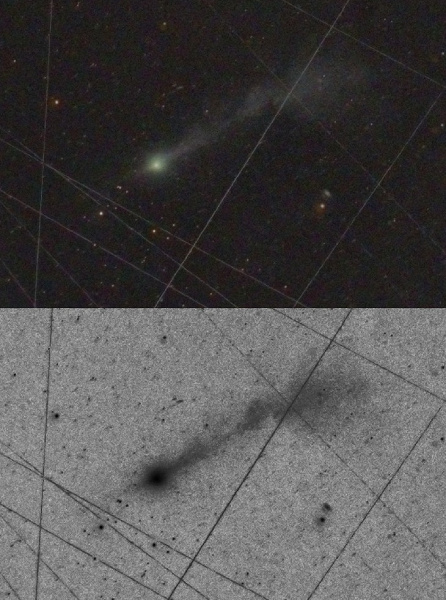
British astronomers Michael Buechner and Frank Niebling captured new images revealing striking gas structures in 3I/ATLAS mimicking an ‘anti-tail’ and a ‘smoking’ trail. Loeb’s calculations suggest one stream of gas extends roughly one million kilometers towards the Sun, while another stretches about three million kilometers in the opposite direction. This sustained ejection at conventional comet speeds indicates a powerful and prolonged gas discharge.
Energy Balance and Surface Area Calculations
Loeb emphasizes the crucial issue of energy balance. Perihelial solar energy inflow to 3I/ATLAS was estimated at roughly 700 Joules per square meter per second. For water ice and carbon dioxide sublimation at calculated rates, 3I/ATLAS’s absorptive surface area must exceed 1,600 km2, equating to a sphere about 23 km in diameter – a significant increase from earlier approximations of 5 km.
Source: Michael Buechner, Frank Niebling
Discrepancies in Observations
The inconsistency is striking when compared with previous telescope data. The Hubble Space Telescope on July 21 provided upper surface area limits sixteen times smaller, and the James Webb Space Telescope recorded mere 150 kg per second mass loss on August 6. The drastic escalation near perihelion requires further elucidation.
Potential Explanations: Core Fragmentation
Loeb and the scientific community ponder scenarios such as core fragmentation, wherein 3I/ATLAS might have divided into multiple pieces, significantly enlarging the total surface area and accounting for phenomena like robust jets and brightening. Loeb estimates fragmentation into ‘at least 16 equal parts, likely more,’ akin to a ‘fireworks’ display near perihelion.
Awaiting Further Evidence
Definitive conclusions are premature. Observations in coming months will provide insight into whether 3I/ATLAS disintegrated or maintained integrity under extraordinary gas emission conditions. Its near-Earth and Jupiter passages in December and March will yield vital data, potentially redefining our understanding of this interstellar voyager and the mechanisms shaping its evolution.