
Since its launch in 2021, NASA’s James Webb Space Telescope (JWST) has been orbiting approximately 1 million miles from Earth. Unlike the Hubble Telescope, JWST is designed for long-term remote operations, making it non-serviceable by astronauts. The telescope’s cutting-edge technology, however, faced a serious challenge with its ultra-precise infrared cameras. These cameras were producing blurred images due to electronic distortions in the sensor array, affecting their ability to distinguish faint objects near bright stars.
Breaking Down Technical Barriers with AI
The main challenge involves the Aperture Masking Interferometry (AMI) mode, a key element for JWST’s sensitive observations. AMI employs a thin metallic mask with apertures to transform the telescope’s mirror into a series of ‘mini-telescopes,’ enhancing optical accuracy and the detection of faint light sources near bright objects. However, intensified electronic effects-charge leaks from bright pixel regions to neighboring areas-were distorting these critical measurements.
AI to the Rescue: The Introduction of AMIGO
In response, two Australian scientists developed the AMIGO (Aperture Masking Interferometry Generative Observations) system. This artificial intelligence algorithm simulates the telescope’s optical and electronic behavior, computationally correcting charge leakage between pixels. Essentially, they enhanced the tool’s performance through code rather than physical modifications. Initial results have shown that AMIGO not only restores AMI data quality but also boosts observation efficiency beyond its original state.
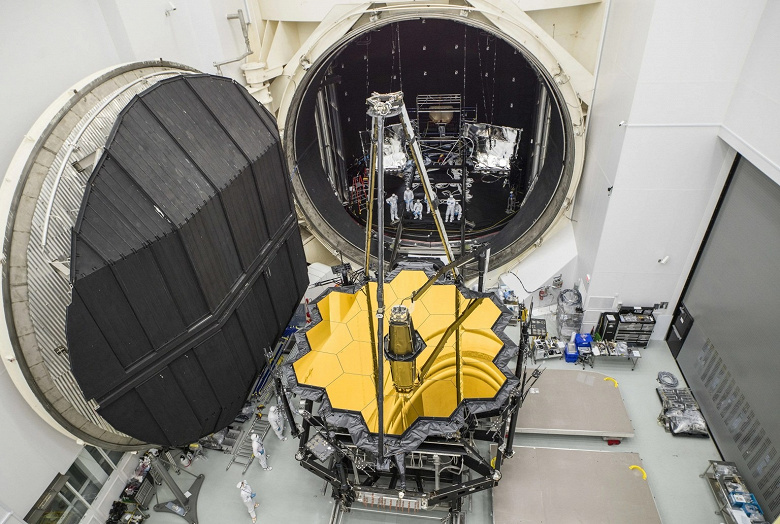
Source: NASA / Chris Gunn
Proven Success and Future Implications
AMIGO’s initial tests are documented in two University of Sydney studies. Led by postgraduate Louis Desdoigts, one study used the new algorithm to correct distortions while observing the HD 206893 system approximately 133 light-years away. Before AMIGO, astronomers were aware of an exoplanet and a brown dwarf in the system but could not reliably image them against the star’s blinding light. Post-correction, both entities were distinctly visible, showcasing AMI’s improved capability to confidently locate very faint companions near bright stars.
In another study, researchers applied AMIGO to some of JWST’s most complex targets, achieving sharper images of substance jets from black holes, dust from binary stars, and active volcanic regions on Io, Jupiter’s most geologically active moon. In each case, the AI algorithm enhanced the clarity of subtle structures previously clouded by electronic noise.
Looking Ahead
The creators of AMIGO acknowledge that the system is still developing, but its current success illustrates the potential of software solutions to overcome the limits of complex space observatories. This approach, validated with JWST, is considered promising for future missions, including the Nancy Grace Roman Space Telescope, set for a May 2027 launch. With a wide field of view-100 times greater than Hubble’s-it will benefit from advanced data processing techniques to search for distant galaxies, dark energy, and new exoplanets.