





 |
The non-technological system that personal accountability officers have used/currently use to track fellow firefighters can be cumbersome, limiting and inefficient. Examples are: 1) Writing each firefighter's name on a dry-erase board, which often results in illegible hand-writing/lost data; 2) Collecting each firefighter's "tag" and placing it on a ring, which doesn't track a firefighter's location; and, 3) Collecting each firefighter's tag and clipping it to a board, which doesn't "time stamp" how long a firefighter has been working on an often dangerous assignment. "Using a hand-held computer-based solution for monitoring firefighters makes a personal accountability officer's job much easier," says Ellis. "The
PAR software provides improved efficiencies that minimize human error during
the stressful job of managing a fire or emergency." Benefits of using technology to account for firefighters at a scene versus
using a manual system include: 1) Reduces human errors by more than 50 percent. How? Using a pocket PC eliminates the task of listing names by hand using
pens, markers, grease pencils, etc., which can result in illegible hand-
writing. Also eliminates the risk of forgetting to list a firefighter's
location. 2) Increases efficiencies by up to 75 percent. How? A point-and-click system provides a detailed, chronological report
of the entire incident, post-incident. Eliminates dependency on pages and
pages of paper, which can take several minutes to sort through. 3) Helps prevent injuries or loss of life. How? The software has built-in safety features that time stamp the length
of time each firefighter has been working in a dangerous location such as the
basement of a house, roof top of a church or outskirts of a forest fire. 4) Establishes benchmarks and identifies opportunities for
improvement/training. How? Built-in defaults of PAR require the personal accountability officer
to account for nearly all aspects of an incident. Once the incident is over,
the personal accountability officer can use the data from the post-report to
evaluate opportunities to improve. 5) Upgrades the professional service firefighters provide to their
communities. How? Embracing technology demonstrates a fire department's goal to
improve and keep in step with today's technological age, similar to upgrades
that fellow first responders in their communities have made to improve
performance and better serve community members. "This tool is perfect for standard incidents and alarms, and it is the
type of unit that will eventually be utilized on all alarm scenes," says
Deputy Chief John Evans, West Valley City Fire Department, West Valley, UT.
The West Valley Fire Department is the second largest fire department in the
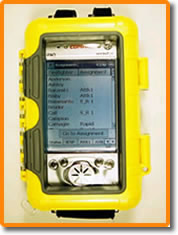
State of Utah. A patent for PAR is pending. The software and its accompanying Hewlett
Packard iPaq hand-held PC is designed for use by firefighters at small-,
medium- and large-sized departments. Headquartered in Chesterfield, Mich., Incident Command Technologies, Inc.
(ICT) strives to continuously research and evaluate all aspects of the Fire
Services industry, and develop technological solutions in these areas to bring
increased safety to the dangerous job of firefighting. ICT was formed to
prevent injury and loss of life to firefighters through the development of
technology products, and the Fire Services' use of these products. The Fire
Services technology company's products are designed to service small-, medium-
and large-sized fire departments in the US, and in other parts of North
America. ICT partners with re-sellers in Michigan, Missouri and Ontario,
Canada. To learn more about ICT and/or PAR (Personal Accountability Recorder),
visit www.ictinc.org .
